What's making headlines today? If it’s a boring fact (let’s assume that is boring for a second), like, "The Bible is a reliable book, historically proven!" would you click on that link?
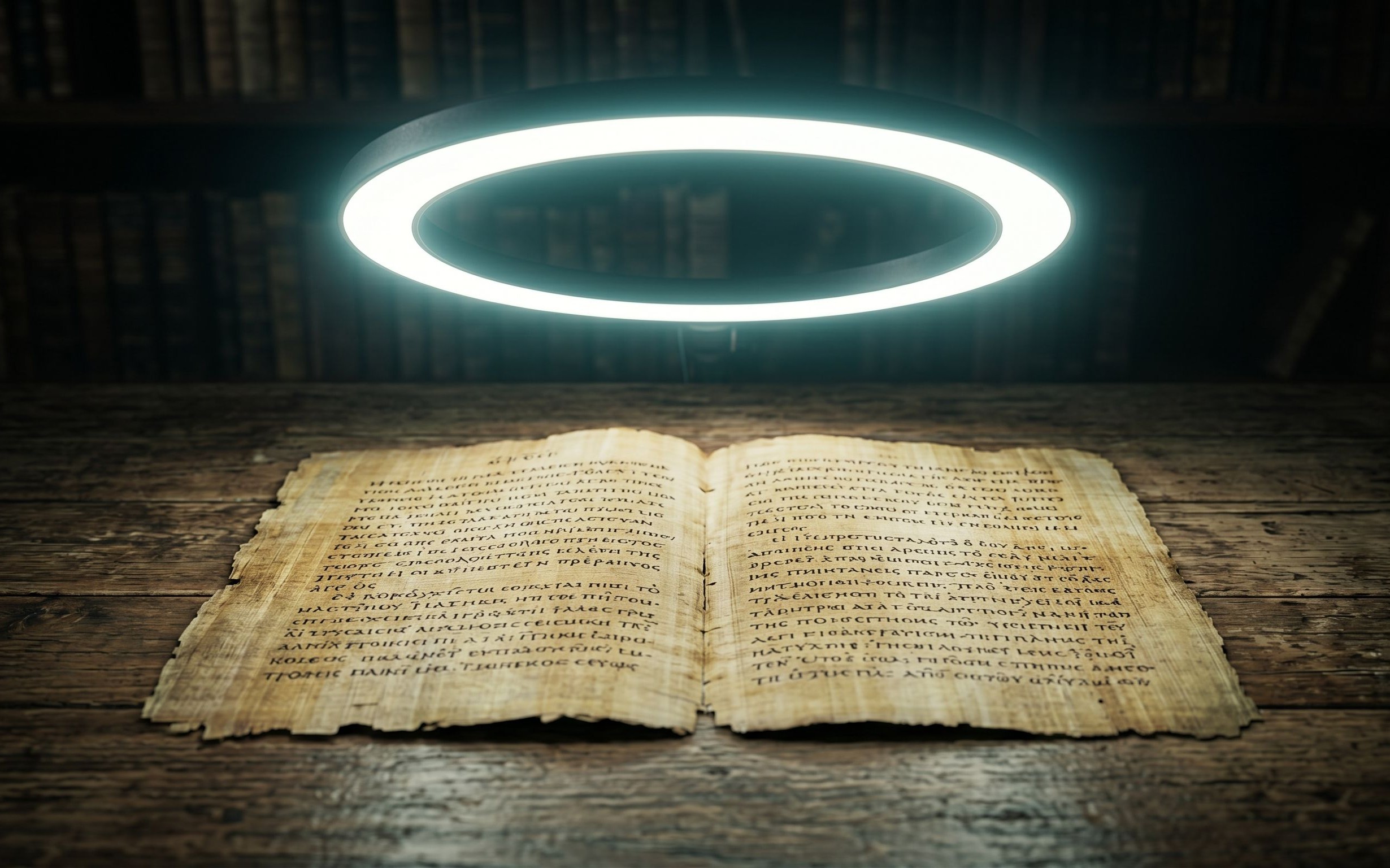
But what if it’s a sensation? A mystery? You have probably come across them on your feeds. A lot of these TikTok preachers staring into their ring lights ask: "Could the Gospel of Thomas be a lost part of the Bible?" or "Did Jesus secretly marry Mary Magdalene?"
Here’s what I want you to notice: see how those headlines always end with a question mark? That is because they are made for sensation, "what ifs," and rumors. But when we look at the historical record, and when we examine the actual evidence from both believing and skeptical historians, the reliability of the Bible consistently ends with a period.
As a pilgrim on this progress, these thoughts and questions aren't just for scholars doing PhDs. If you are in high school or college right now, or if you are a lay member of a church, these are battles for all of our hearts and minds.
I am not just going to say, "Just have faith." I want to take you on an academic history trip through the manuscript science and the theology of why the Bible we hold today is historically attested and proven. We are going to look at three things:
1. Why the 66? The Recognized Canon
Many people assume a bunch of powerful men, like Emperor Constantine and others, "invented the Bible" at a meeting like the Council of Nicaea in 325 AD, sitting in a dark room. Thanks to authors like Dan Brown and books like The Da Vinci Code, Google shows that more than 80 million copies of that narrative were sold. I don’t know how many millions of people have watched the movie, nor how many actually believe this rumor.
But do you know where that rumor actually comes from? It comes from a bizarre 9th-century Greek document called the Synodicon Vetus. It claimed that at Nicaea, the bishops put all the known books on a divine table, prayed, and God magically made the "fake" books fall underneath the table while the real ones stayed on top. It’s an absurd legend; this is more or less the story of a man coming out of a cave and saying, "God gave me this book!" Skeptics like the French philosopher Voltaire put that story in his encyclopedia just to mock Christians. Absolutely no serious historian believes this happened.
As a matter of fact, the Council of Nicaea didn't even discuss the books of the Bible. They met to discuss the Trinity, specifically to address a heresy called Arianism. This was a major 4th-century theological movement initiated by Arius, a priest in Alexandria, Egypt, which taught that Jesus Christ was a created being rather than co-eternal or consubstantial with God the Father. It caused massive, century-long divisions, prompting the Council of Nicaea in 325 AD to condemn it and officially define the orthodox belief in the full divinity of the Son. The church didn't need a council to tell them what the Bible was; they had already been reading the Apostles' letters for 300 years.
The word Canon comes from a Greek word meaning a "reed" or a "measuring stick." Eventually, early Christians used it to mean the "rule of faith": the exclusive list of authoritative books. The 66 books you hold in your hand were not "chosen" or created by a committee; they were recognized by the global church.
The Old Testament (The Tanakh)
When we talk about the Old Testament, we aren't looking at a book that fell out of the sky. We are looking at a collection of books that were divinely inspired by God over the span of 1,000 years. From Moses to Malachi, kings, shepherds, and prophets composed these 39 books.
Around 95 AD, the Jewish historian Josephus noted that the Jews have only ever had 22 authoritative books. You might think, Wait, we have 39! But they had the exact same books; they just organized them differently. All 12 Minor Prophets were counted as one scroll. First and Second Samuel were one book. By the first century BC, the Old Testament was already a closed case.
The grandson of a Jewish writer named Sirach wrote a prologue to his grandfather's book (Yeshua ben Eleazer ben Sira). In it, he specifically mentions that the Jews possessed "the Law and the Prophets and the others that followed them." This proves that 130 years before Jesus, the three-part structure of the Old Testament was already standard.
We know this isn't just an oral tradition or a game of telephone because of the Dead Sea Scrolls. In 1947, archaeologists discovered scrolls dating back to 200 BC. Compared to the Bibles we use today, they were virtually identical. It was the ultimate "period" at the end of the question of whether the Old Testament has changed. Jesus Himself treated it as authoritative history, stating plainly, "Scripture cannot be broken" (John 10:35).
The New Testament
I see many skeptics challenge the Bible. It actually helps to look at how historians treat other famous ancient books. We trust ancient history without blinking, yet the evidence for the Bible blows all other texts away, absolutely crushing them:
- Socrates (c. 400 BC): He wrote exactly 0 manuscripts. Everything we know is from his students.
- Plato (c. 400 BC): We have only 7 early copies, written 1,200 years after he died.
- Julius Caesar (c. 50 BC): We have about 10 copies, with a 1,000-year time gap.
- Homer's Iliad (c. 900 BC): The second best-attested book in history. We have over 2,000 copies, with a 500-year gap.
Now, let's compare that to the New Testament. While Caesar has 10 copies, we have 5,800 handwritten Greek manuscripts of the New Testament predating the printing press (and over 25,000 if you include early translations like Latin and Syriac). And the time gap? Not a thousand years. We have fragments dating to within decades of the originals:not centuries, just decades.
The New Testament wasn’t simply voted on. It was an organic process based on strict criteria:
- Apostolicity: Was it written by an eyewitness?
- Orthodoxy: Did it match Jesus’s actual teaching?
- Universality: Was it used by the whole church, or just one isolated group?
We might think Gen Z or millennials are skeptics, but the early church was highly skeptical. There is an academic concept called the Antilegomena (books "spoken against"). Early Christians fiercely debated books like Hebrews and 2 Peter. This again proves there was no conspiracy; the church was doing its homework to ensure only the truth was included.
You might hear skeptics point to the Council of Carthage in 397 AD and say, "See! A council did vote on the New Testament!" But look at their actual historical documents. They didn't declare, "We decree these 27 books are now the Bible." Their official statement was that they were simply recognizing "exactly those which are generally received by the people at the time." They weren't making a new law; they were publicly confirming what the global church had already been doing for centuries.
2. What About the "Lost" Gospels and the Apocrypha?
I was trying to make a point in my first section on the historicity and the reliability of the Bible, yet this is where the "question marks" come back. Many fail to do the research, watching a 30-second reel and thinking they learned some solid facts. We hear about "missing" books, but early Christians actually put these ancient writings into three distinct categories: Canonical (for establishing doctrine), Readable (for historical edification), and Apocryphal (heretical forgeries).
The Deuterocanon (The "Readable" Books)
If you open a Catholic or Orthodox Bible, you'll see extra Old Testament books like Maccabees or Tobit. These are the Apocrypha. They were written in the 400-year gap between the Testaments. In the 4th century, there was a massive debate between two big-name early church fathers: Jerome and Augustine, who were two of the most influential Latin scholars and theologians of the early Christian era.
- Jerome argued for the Hebrew Criterion: If the Jews didn't have it in their 22-book canon, it's not Scripture. It's just a good history book.
- Augustine argued for the Church Criterion: Since some churches read them, they should be included.
For 1,500 years, the church essentially agreed with Jerome. Even early Catholic printed Bibles separated these books. They treated them like historical books that were in the room for historical context, but they weren't the main characters.
But the plot thickens. In 1546, as a reaction to the Protestant Reformation, the Catholic Church met at the Council of Trent. They held a vote and officially declared the Apocrypha to be sacred and canonical. For the first time in church history, they attached an anathema (a formal curse) to the Canon list, stating that if you refuse these extra books, "let him be anathema." They literally redrew the boundary lines of the Bible. We didn't take books out of the Bible; we simply refused to accept the books that a 16th-century council dogmatically declared as scripture, sticking with the original 66.
The Gnostic Gospels
Now, let's talk about some other real rumors we see online: the "Gospel of Thomas," the "Gospel of Judas," or the "Gospel of Peter."
TikTok will tell you the church "hid" these to control people. Is that the truth?
The church rejected them because they were heretical fakes. They were written by groups called Gnostics 100 to 300 years after the eyewitnesses were dead. Biblical Christianity teaches that salvation comes from the outside, through Jesus rescuing us. Gnosticism taught a radical dualism where physical matter is evil, and salvation comes from unlocking an internal "secret knowledge" (gnosis).
Let's look at the actual facts of these "lost" books:
- The Gospel of Peter: Because Gnostics believed physical matter was evil, they were Docetics: they didn't believe Jesus had a real physical body, meaning He couldn't really die or resurrect. In their bizarre resurrection story, there are no women at the tomb. Instead, Roman guards watch a giant, talking cross walk out of the grave.
- The Gospel of Judas: You might remember National Geographic making a huge deal out of this discovery a few years ago. But if you actually sit down to read it, you will find it is incredibly bizarre and impossible to follow. That is not an accident. Gnostic literature was deliberately confusing on purpose. It was designed to sound deep and mysterious so that only the "enlightened elite" with secret knowledge could understand it. It wasn't meant for everyone; it was meant to exclude people.
- The Gospel of Thomas: It's not even a narrative gospel; it's just a list of 114 weird sayings that aren't even unified. A gospel, by definition, is a unified story of the life, death, and resurrection of Christ. You want to know why it's not in the Bible? Listen to the very last line. Peter tells Jesus to kick Mary out, and Jesus says: "I myself shall lead her in order to make her male, so that she too may become a living spirit... For every woman who will make herself male will enter the kingdom of heaven."
Do you think that sounds like the Jesus of the Bible? No. They weren't "lost"; they were universally rejected because they lacked the truth.
3. Defending the Faith: Inspiration Meets Evidence
When we get attacked or feel attacked as believers, we should be able to defend our faith. Our defense should be rooted in both Science and the Spirit. We can confidently stand on the historical reliability of the text, but we must also understand its divine nature. If we believe what we believe, we should be able to defend what we believe.
We are certainly equipped on one level when we study, but we are equipped much more deeply if we put into practice what we've studied. Two people I highly recommend studying regarding this topic are Wes Huff and John Meade. I used their content, along with other books, to prepare for this message. As you study, make sure to have conversations with people so that you may become confident in this topic or any other area of apologetics.
Inerrancy and Infallibility
We went through a lot of history, but I want to close with something that happened more recently. In 1978, over 200 scholars gathered to write the Chicago Statement on Biblical Inerrancy. They affirmed what the church has historically believed: The Bible is inerrant (without error in all that it affirms, including historical and geographical claims) and infallible (it cannot fail in its ultimate purpose of revealing the way of salvation).
But how is this possible with human writers? The Apostle Peter gives us the answer:
"For no prophecy was ever produced by the will of man, but men spoke from God as they were carried along by the Holy Spirit."
2 Peter 1:21
The Greek word Peter uses is pheró, which means "to be carried along." Think of a ship's sails catching the wind. The ship is the human vessel with its own personality and writing style, but the wind provides the power and direction.
The Apostle Paul takes it a step further in 2 Timothy 3:16: "All Scripture is breathed out by God." The word is theopneustos: literally, God-breathed.
When you put all this academic history together, it points to a supernatural reality. We have a collection of 66 books written by about 40 different authors, spread across 3 different continents, over the span of 1,500 years. The Bible contains over 300 messianic prophecies that Jesus fulfilled; the statistical odds of that happening by chance are less than one in 100 quadrillion. Yet, from Genesis to Revelation, it tells one unified, perfectly connected story of redemption. It fits together so flawlessly, it’s almost as if the whole thing was God-inspired... pun intended.
Conclusion
We do not follow "cleverly devised myths." We follow a record supported by ancient manuscripts, Jewish historians, Roman historians, and thousands of archaeological digs.
When you go to class or work tomorrow, or when you open your phone and the world throws a "question mark" at your faith, you can answer with the "period" of history. The Bible is not a book of rumors; it is the trustworthy, reliable, inerrant, and inspired Word of the Living God. As 1 Peter 3:15 tells us: "But in your hearts honor Christ the Lord as holy, always being prepared to make a defense to anyone who asks you for a reason for the hope that is in you; yet do it with gentleness and respect."